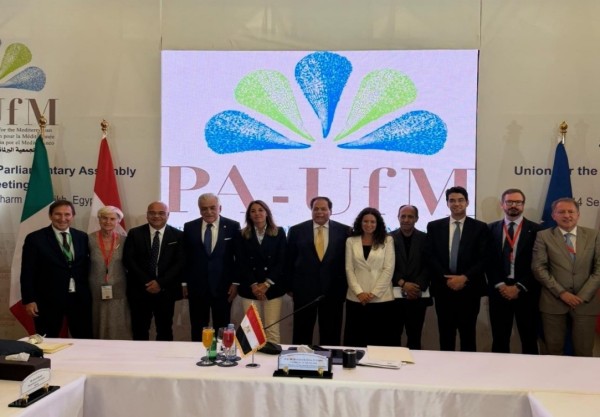
Journalist Ahmed Moussa announced that MP Mohamed Abou El-Enein, Deputy Speaker of the Egyptian House of Representatives, succeeded in leading the Parliamentary Assembly of the Union for the Mediterranean (UfM) to issue a statement condemning the Israeli aggression on the Gaza Strip.
He explained, during his program “Ala Mas’ouliyati” on Sada El-Balad TV, that the sessions witnessed broad consensus and widespread praise for Abou El-Enein’s leadership and for Egypt’s pivotal role in supporting the Palestinian cause.
Abou El-Enein affirmed that the conflict with the Israeli occupation did not begin on October 7, but extends back nearly eight decades. He emphasized that Israel is systematically closing the crossings and obstructing humanitarian aid to the people of Gaza.
He stressed that the situation is urgent and extremely dangerous, and that silence is no longer acceptable in the face of the atrocities being committed and the horrors endured by the Palestinian people.
Abou El-Enein warned that Israel’s plan is clear: a deliberate policy of starvation and targeting of innocent civilians, expanding settlements, and seizing land to forcibly displace Palestinians, aiming to liquidate the Palestinian cause and bury the two-state solution.
He added that what is currently taking place in Gaza — particularly the re-occupation of Gaza City and the northern areas of the Strip — aims to push Palestinians southward toward the Egyptian border in an attempt to force displacement into Sinai, a red line that Egypt absolutely rejects and will never tolerate.
Abou El-Enein further noted that the situation is escalating, as the Israeli aggression has expanded to Syria, Lebanon, Yemen, and Qatar, with Israel acting as though it is a state above international law — a path that threatens to ignite the entire region. “We seek calm, peace, and stability, not escalation,” he said.
“As parliamentarians, we are accountable before our nations, our peoples, and our consciences,” Abou El-Enein told the Assembly. “The peoples of the region and beyond are in a state of overwhelming anger — therefore, our positions must rise to meet their aspirations.”
Responding to claims that the crisis in Gaza is complex and began after October 7, Abou El-Enein clarified that the conflict did not start in 2023 but has its roots in Israel’s occupation of Palestinian land in 1967 and its ongoing denial of the Palestinian people’s right to statehood and justice since the Nakba of 1948.
“The solution,” he said, “lies in ending the occupation and establishing an independent Palestinian state on the 1967 borders with East Jerusalem as its capital — a solution that enjoys overwhelming international consensus.”
He noted that just yesterday, the UN General Assembly adopted a resolution with the support of 142 countries affirming the two-state solution.
Abou El-Enein’s powerful intervention shifted the tone of the debate, prompting participants to express their full support for his position and to condemn the genocide against Palestinian civilians, the use of starvation as a weapon, and the denial of food, water, and medicine. They also reaffirmed the two-state solution as the only lasting framework for peace, and the protection of civilians — especially women, children, and the elderly — as a moral and legal obligation.
In response to Israeli propaganda blaming Hamas for obstructing humanitarian aid, Abou El-Enein made it clear that “the entire world has witnessed that Israel is the one preventing aid from entering Gaza.” He explained that there are six crossings between Israel and Gaza — all controlled by Israel — and that it is Israel, not Hamas, that keeps them closed.
He added that Rafah Crossing has always been open from the Egyptian side, before and after October 7, but that Israel has destroyed it four times, occupied the Philadelphi Corridor, and imposed severe restrictions that allow only a minimal number of trucks to pass. “Starvation,” he said, “has become a weapon to force Palestinians into displacement.”
Abou El-Enein presented a video showing thousands of aid trucks waiting on the Egyptian side of Rafah, noting that 70% of all humanitarian aid entering Gaza comes from Egypt, and that over 6,000 Egyptian trucks loaded with food supplies are ready to enter immediately if Israel lifts its blockade and opens Rafah or Kerem Shalom crossings.
He called on all countries to pressure Israel to open all six crossings fully and unconditionally to allow sufficient humanitarian access.
Abou El-Enein also referred to the recent strong and courageous resolution adopted by the European Parliament, urging that it be used as a foundation for further international action.
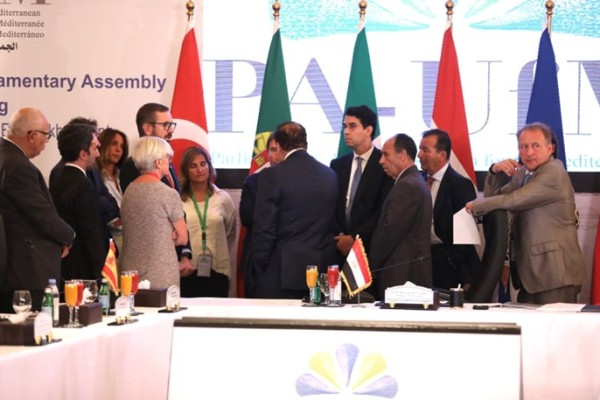
After four hours of intensive deliberations, the Parliamentary Assembly of the Union for the Mediterranean unanimously adopted a strong statement that included the following points:
-
The urgent need for international action to secure an immediate, comprehensive, and sustainable ceasefire in Gaza.
-
Strong condemnation of the Israeli government’s obstruction of humanitarian aid, which has caused famine in Gaza.
-
A call on the international community to intensify efforts to ensure safe and unrestricted delivery of humanitarian aid to all civilians.
-
Rejection of forced displacement and mass transfer of the population.
-
Reaffirmation that the two-state solution remains the only realistic and just framework for achieving lasting peace, security, and coexistence in the region.
-
Condemnation of Israeli retaliatory measures against member states that have recognized or announced their intention to recognize the State of Palestine.
-
Full support for the current international sanctions on violent settlers in the occupied West Bank and East Jerusalem, and a call for full respect of international law.
The Assembly also approved the Egyptian Presidency’s priorities for the upcoming year, including:
-
Enhancing economic integration between both shores of the Mediterranean.
-
Strengthening the role of parliaments in promoting peace and stability in the Middle East.
-
Advancing youth policies, women’s participation in decision-making, and child rights as pillars for a stable and sustainable future in the region.
It further approved Egypt’s proposal to host a major Economic Cooperation Conference in Cairo on 28–29 November 2025 to celebrate the 30th anniversary of the Barcelona Process, preceded by meetings of the five UfM committees to prepare their reports and recommendations.
Additionally, the Assembly endorsed Egypt’s proposal to organize a Conference on Youth and Women’s Empowerment Policies, to be held in Cairo from 23–24 April 2026.
At the conclusion of the meeting, participants gave MP Mohamed Abou El-Enein a standing ovation for his strong stance, passionate defense of peace and stability, and tireless efforts to ensure that the Assembly’s resolutions reflect the aspirations of the peoples of the region.
They described the adopted statement as “the strongest ever issued by any international parliamentary organization.”